A bat, a ball and a friend
When I was a schoolboy, playing cricket was very different from what most people understand cricket to be.
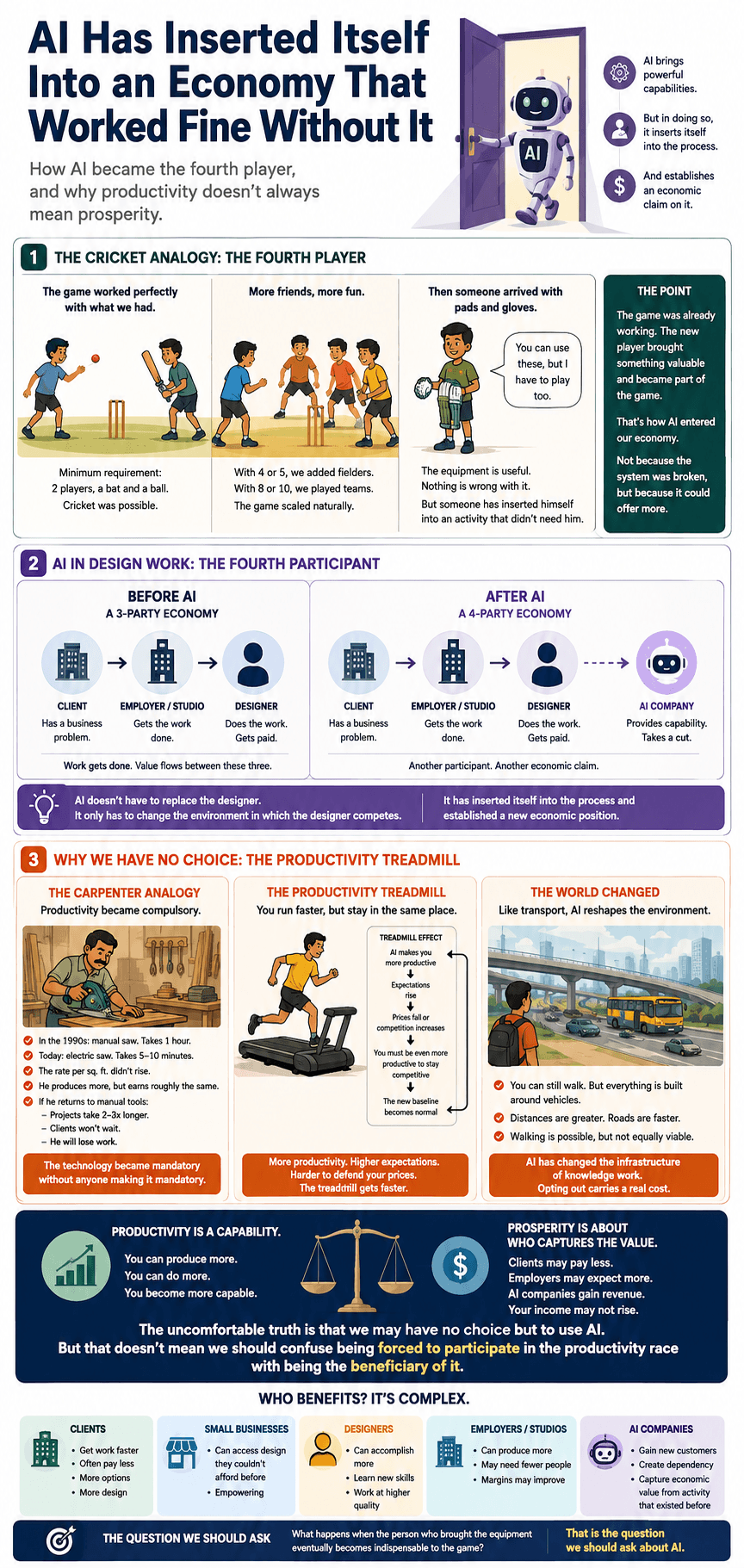
For us, the minimum requirement was remarkably small: two boys, a bat and a ball.
One person would bowl. The other would bat. There were no fielders, which was obviously a disadvantage, but that disadvantage was shared equally. If four or five of us were available, we still played the same way, with one person batting, one bowling and everyone else fielding. When we had eight or ten people, we could finally divide ourselves into proper teams.
The important thing was that cricket did not require much infrastructure.
Now imagine that a third boy arrives with pads and gloves.
He says, “I have all this equipment. You can use it. But if you want to use it, I will to play too, and since I bring this kit, I will bat twice.”
The equipment is useful. There is nothing wrong with the equipment. The game might even become better because of it.
But notice what has happened.
Someone has inserted himself into an activity that was already working perfectly well without him.
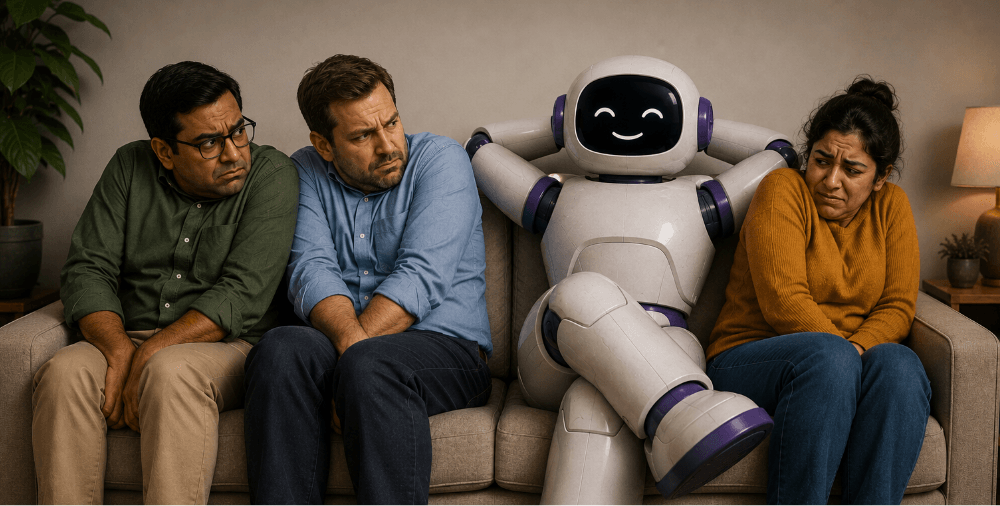
This is increasingly how I think about AI.
The fourth player
Consider how design work used to happen.
Ten years ago, I might have been working for an employer using Sketch, Photoshop or another design tool. A client paid my employer to get work done. My employer paid me a salary. The client got the work, the employer made money from delivering it, and I got paid for my labour.
There were three participants in this economic relationship: the client, the employer and the employee.
The tools mattered, of course. Software made the work possible and increasingly efficient. But the software company wasn't necessarily inserting itself into the economics of every piece of work we produced.
Now there is a fourth participant.
Companies such as OpenAI, Anthropic and others have inserted themselves into the production of knowledge work.
The client still has a business problem. The employer still has work to execute. The designer still has a job to do.
But now another company sits inside the process and provides part of the capability through which that work gets produced.
And that company has created an economic claim on the activity.
This is the part of the AI story that interests me more than the question of whether AI will replace designers.
Someone else reaps the benefits of your increased productivity
We are constantly told that AI makes us more productive.
That is true.
I use ChatGPT and Claude myself. They allow me to do things much faster. I can create designs, HTML, prototypes and other things in a fraction of the time they might previously have taken.
But there is a problem with the way we talk about productivity.
We often assume that if an individual becomes more productive, that individual automatically becomes better off.
Why should that be true?
If I can produce twice as much work in the same amount of time, but the market expects twice the output for the same fee, my productivity has increased but my income has not.
In fact, if the client expects the work to be completed faster and is willing to pay less for it, the economic value of my time may actually have fallen.
I have seen this first-hand through my consulting work.
The timelines for projects have shrunk. The expectation to produce designs much faster is now very real. At the same time, the amount clients are willing to pay for comparable work has reduced.
Earlier, there were projects we would simply turn down because the budget was too small. Today, AI makes it possible to execute work faster, but that has not necessarily opened up a new, profitable category of clients for us.
A client who might previously have been willing to pay ₹50,000 may now expect the same work for ₹30,000. The client that was not viable for us yesterday is not viable for us today either.
It has not automatically become additional income for the designer.
Productivity is a capability. It is not, by itself, a benefit. The important question is who captures the value created by that productivity.
Higher productivity is the new normal
There is another consequence of becoming more productive.
The new level of productivity becomes the baseline.
If AI allows a designer to produce something in one day that previously took three days, the market does not necessarily say, “Excellent. You have gained two days of your life back.”
Instead, the expectation becomes that the work should now take one day.
And once everyone can do it in one day, one day becomes normal.
This is what I call the productivity treadmill.
You become more productive. Expectations rise. Prices fall or competition increases. You become more productive again simply to remain competitive.
The treadmill gets faster, but you don't necessarily move forward.
That is why “AI will make you more productive” is an incomplete promise.
More productive for whom?
The designer produces more. The client may pay less. The employer may expect more output. The AI company gains another customer or another source of revenue.
The same productivity gain can create very different outcomes for different participants in the system.
The Carpenter and the Frozen Hourly Rate
A few years ago, I was talking to the carpenter who had done the woodwork in my home.
He started his career in the mid-1990s. When he did the work for me, he charged around ₹225 per square foot.
What struck me was that the rate for the kind of work he did had remained roughly around the same level for decades.
But his productivity had changed dramatically.
When he started, he used a manual saw. Something that took him an hour could now be done with an electric saw in five or ten minutes. Drills and other power equipment had similarly reduced the time and physical effort required to do his work.
He was able to produce much more in the same amount of time.
But he was still working. And the rate he could charge had not increased in proportion to his productivity.
Could he stop using the electric saw?
Technically, yes.
Economically, no.
If he returned to manual tools, a project that could be completed in one month might take three. Even if he decided that he is okay with his income dropping to a third of what he makes with electrical tools, a client who has bought a house and wants to move in is not going to be happy to hear that he will have to wait for three months.
The technology has therefore become compulsory without anyone actually making it compulsory.
The market doesn't have to mandate a technology for that technology to become mandatory.
That is exactly the position designers increasingly find themselves in with AI.
I can choose not to use ChatGPT. I can choose not to use Claude. But if other designers are producing faster, if clients expect faster delivery, and if the amount clients are willing to pay has fallen, choosing not to use AI has a direct economic cost.
I HAVE to use it.
मुझे झक मार के यूज़ करना ही पड़ेगा।
Technology changes the environment

This is also why I keep coming back to the analogy of transportation.
Transport has given us enormous benefits. We can live farther from work. We can travel much greater distances. We can move people and goods quickly.
But transportation infrastructure has also changed the environment around us.
If you want to walk everywhere today, you technically can. But the world has been reorganised around roads, cars, flyovers, underpasses and other forms of transportation. Distances are greater. Traffic is heavier. Spaces that were once easy to cross have become harder to navigate on foot.
Nobody has formally banned walking.
Yet the system has changed so much that walking is no longer an equally viable alternative in many situations.
AI is doing something similar to knowledge work.
It isn't simply giving us another tool we can choose to use or ignore.
As adoption spreads, it changes the expectations surrounding everyone else.
If everyone else is using AI to produce faster, then not using AI means you are slower.
If everyone else can produce more cheaply, then not using AI makes your work more expensive.
If everyone else can create ten alternatives in the time you create two, then producing two alternatives no longer looks like normal productivity.
The environment has changed.
AI doesn't have to replace the designer
This is why I am less interested in the question of whether AI will replace designers.
It certainly may eliminate some jobs. We have already seen design work become accessible to people who previously couldn't afford a designer or couldn't produce the work themselves.
A corner shop can create a flyer. A small restaurant can create a menu. A shop owner can produce social media posts.
That is genuinely empowering.
But it has another consequence.
The jobs of some designers disappear. At the same time, the total amount of design being produced can increase because design has become cheaper and easier.
More design does not necessarily mean more designers.
And AI does not need to replace the designer to change the designer's economic position.
AI doesn't have to replace the designer. It only has to change the environment in which the designer competes.
Once the productivity baseline changes, the designer gets pulled onto the treadmill.
The work becomes faster. The expectations become higher. The prices become harder to defend.
And the technology that caused the shift becomes something we have to learn, integrate and continually use simply to remain competitive.
Who is capturing the value?
This brings me back to my original question: who benefits?
There are certainly benefits distributed across the system.
Clients can get work faster and cheaper. Small businesses can access design they previously couldn't afford. Designers can accomplish things they couldn't have done before. Employers may be able to produce more with fewer people.
These benefits are real.
But there is one participant that wasn't part of this economic relationship before.
The AI company.
The client existed before AI. The employer existed before AI. The employee existed before AI. The underlying business activity existed before AI.
AI has inserted itself into that activity and established a new economic position.
That is why I find the cricket analogy useful.
The boys were already playing cricket. The game worked. Someone arrived with better equipment and made the game easier or better, but in exchange became part of the game.
There is nothing inherently wrong with that.
The question is simply: what happens when the person who brought the equipment eventually becomes indispensable to the game?
That is the question we should ask about AI.
This isn't an argument against AI
I am not a Luddite.
I am not arguing that AI should not exist. I am not arguing that designers should refuse to use it. And I am not denying the enormous capabilities it gives us.
Technology has genuinely improved people's lives in many ways. Making dangerous work safer is a benefit. Reducing physical effort is a benefit. Giving people access to capabilities that were previously unavailable to them is a benefit.
My argument is narrower.
An increase in productivity does not automatically become a benefit to the worker who became more productive.
We need to distinguish between the capability technology creates and the economic value captured from that capability.
Those are not the same thing.
We may have no choice
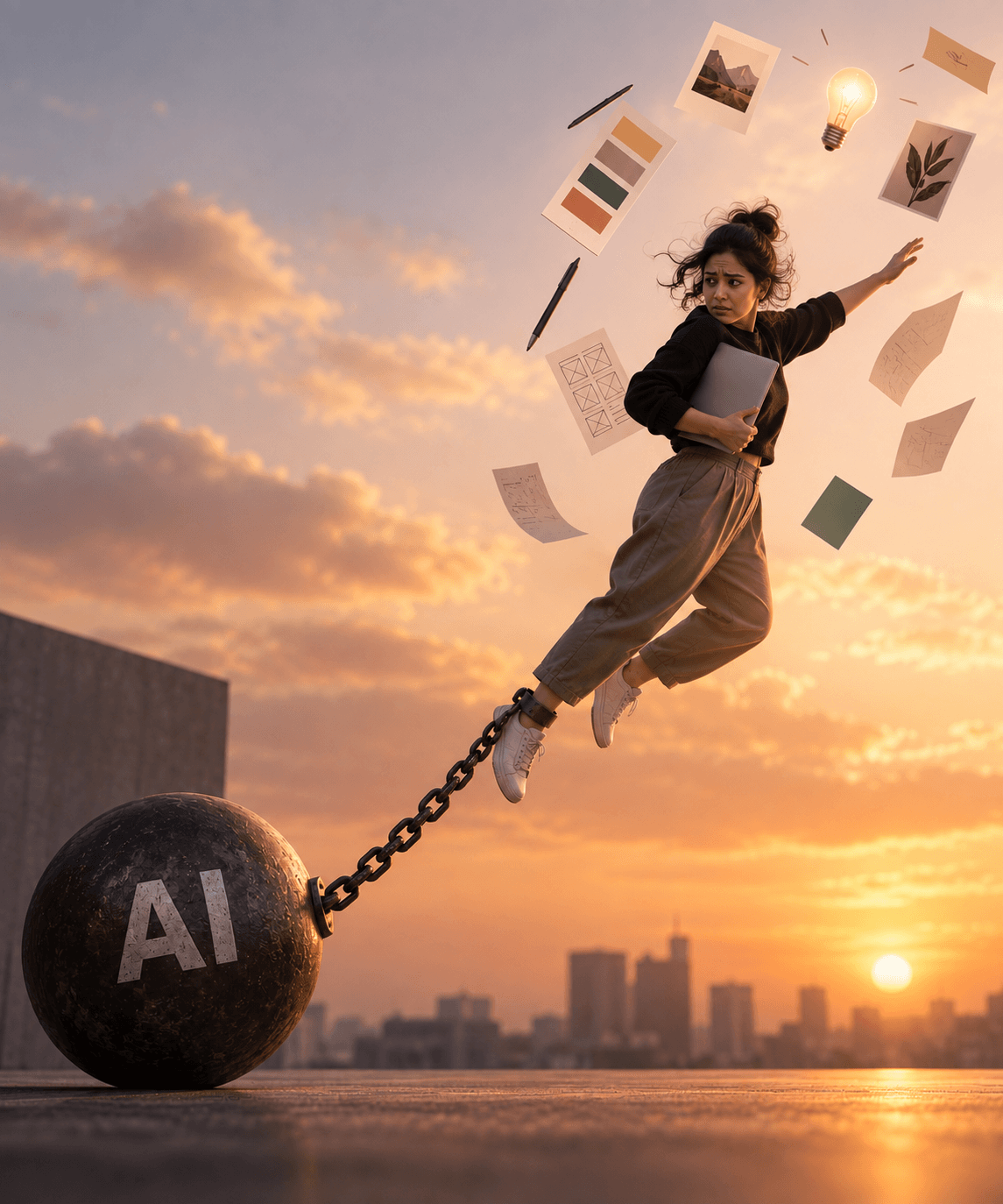
The uncomfortable conclusion is that there may be no individual solution to this.
My carpenter cannot realistically return to the manual saw. I cannot realistically decide that I will never use AI while everyone else becomes faster. A designer inside a large organisation may have even less choice because the tools and workflows are built into the organisation itself.
The question is therefore not whether we will use AI.
We probably will.
The question is whether we understand what is happening when we do.
AI has made us more productive. But productivity has always been about more than how much an individual can produce in an hour. It is also about who captures the value of that additional output.
The uncomfortable truth is that we may have no choice but to use AI. But that doesn't mean we should confuse being forced to participate in the productivity race with being the beneficiary of it.
The treadmill may be getting faster.
We should at least ask who is building it, who owns it, and who is getting paid every time we run.
The Irony
And there is an irony I cannot ignore: I wrote this article with ChatGPT.
It is a little like organising a protest against Chinese products and then getting a banner printed in China that says, “Ban Chinese products.”
Perhaps that irony is itself the point. The system is already here, and I am already participating in it. I can criticise it, question it and examine who benefits from it, but I can't escape it.