
A few days ago I came across this post on LinkedIn.
This is rage bait, and it is quite good in that sense. It manages to outrage two completely different audiences at the same time, ensuring even higher engagement than you would get by outraging just one group.
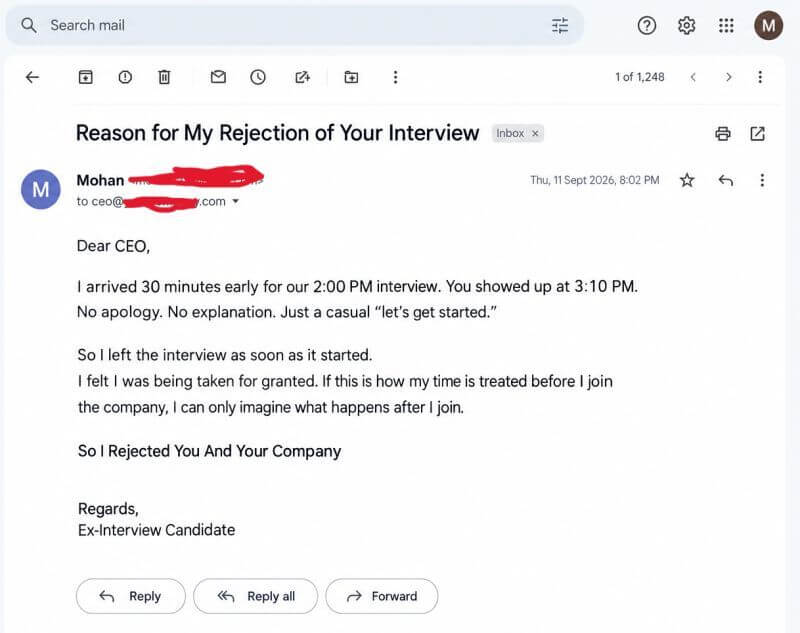
The first group is the candidates. People who have been to interviews and have faced a problem like this first hand, or have heard stories like that. There are also people who may not be as outraged as someone who has experienced it personally, but are outraged enough to engage because they generally dislike bosses, or see them as bourgeois and hate them for it, and so on.
They are commenting: How can a company do this? This is arrogant. You can't waste someone's time like this.
The second group is made up of CEOs and interviewers who feel that a candidate is completely irrational to behave like this. They don't really understand how people are busy and sometimes these kinds of things happen. This is not how people are usually treated.
Then there are the HR and Talent Acquisition people who feel that candidates don't know how hard it is to schedule an interview, to find a time convenient to both sides. Sometimes something like this happens. There are people whose interviews take longer. A CEO gets engaged somewhere else. Things happen. Candidates should have a little more understanding.
The interesting thing about the post was not that it outraged people. It was that it managed to make two completely different groups outraged at the same time.
Now, before I move on to my take on this, I want to talk about a concept that I have named porn logic.
When porn was in a movie format, it followed a storyline. But to maximise the effect of the movie, they wouldn't spend much time on the plot or the story. They would take the flimsiest of excuses to get two people, sometimes even more, in bed.
When I find an excuse that is so flimsy to advance the plot, I call it porn logic.
And this is where the tension comes in.
Like an average person, I didn't see the post and felt outraged by one reason or the other. I could see, as clear as a day what it actually was - a thinly veiled made up store posted with the desire to get engagement.
See, the problem is not that I can see it, the problem is I can see it, and can't move on. I start constructing this whole incident in my mind as how it would have happened.
So you are claiming you went for an interview and were made to wait and then gave them a piece of your mind? Alright. Let's walk through it. The game is afoot.
The candidate went for an interview. He got there early. Then he waited for the CEO to come, who was late.
Now, the time that he spent because he came in early is not really the fault of the interviewer or the company. He did that on his own. The company is definitely responsible for the time the CEO made him wait after the scheduled time.
But where was he waiting?
He wasn't sitting in a conference room or the office of the CEO where the interview was supposed to happened. He must have been waiting in reception.
When the CEO was ready to see him, somebody must have gone to him and said, “Can you please come with me? The CEO is ready to see you.” escorting the candidate to the office, or a conference room, or wherever the interview was supposed to happen.
SDo our hero wet there.
At what point did he said, “Okay, I am walking out now because you made me wait.” Did he just walked in, said this and walked out, did he wait for the CEO to ask a question or start a conversation and then said it?
I get it that you are upset that soemone doesn't respect your time, so just walk away. Why do you kept waiting and wasting even more time. What was your threshold, how much of wait you were okay with and why did you hung around after that time?
You know what, maybe he went ahead with the interview and was rejected, and to vent his frustration he made up this story like this.
Let's assume for a minute that this is what happened.
But tell me: he hasn't named anyone, so he cannot really be venting. If you are angry enough to write a LinkedIn post, you are angry enough to call them out.
And if he has already told the CEO, “I am leaving because you made me wait,” did he really have to go back home and then open his phone or his laptop and write an email to the CEO saying, “I left because you made me wait”?
You have already told him.
Maybe if you just waited for some time, the CEO didn't come, and you left, then you could have sent him an email. But you met the CEO and you are still sending him an email.
Is there really a reason to say something like that? Or, this is a story made up by a person hungry for likes. Then distributed by gullible people.
Now my mind doesn't go in this order, it works like a Christopher Nolan movie - starts in the middle and then goes to the beginning, I just put this in the right sequence so it is easy to follow. Here are the things that I actually noticed.
The tag after the subject is “Inbox”, which means the screenshot was taken from the inbox of a CEO.
Why is a CEO who has been told that their company made someone wait, and then that candidate left, taking a screenshot and circulating that?
Does he really want to be doing that? Why would he want to do something that would put their company in a bad light?
And then look at the email ID. It is CEO@companyname.com.
How you ever seen even a single CEOs in your life who has that kind of an email ID?
I can imagine customer service being like that. Customer-service@XYZ.com. or maybe sales@company-name.com. Those kinds of email IDs exist.
But not for a CEO, and for good reasons, not vanity that a CEO would want his name and not a position in his email address.
Imagine the CEO, after two year, decides to step down. Or he joins the board and is not going to be the CEO anymore. Somebody else is going to take the job of CEO.
What happens to the email ID in that case? Will he keep that email even when he is not a CEO or the new CEO will have that mail abd recieve 15 newsletter that his prececosor signed up for? while the old CEO has a mail ID like boardmember12@company-name.com?
Makes perfect sense, doesn't it? It is perfectly logical thing to do.
This is what my mind sees when I look at the post.

Three or four hundred people had engaged with that post. A lot of other people must have seen it and felt some kind of outrage, probably not enough to comment or like or engage with the post, but they must have felt it and then just moved on.
But my mind doesn't do that.
It goes into all those unnecessary things that it doesn't need to think about.
I mean, I am sure my mind would be better off concentrating on things I have to do, on my work. But no, my mind is Hercule Poirot on a mission. It occupies itself with a useless quest from which I gain nothing. When I say I gain nothing, I am talking about the best case scenario. The worse case scenario is that the message is posted by a friend and I pointed it out and now he is upset with me for implying he is an idiot to reshare a message like this.
And this is one thing about being an experience designer: everything in life is seen with this lens.
As it must be obvious to you, and even to the gull who reshares these messages, this is both a challenge and an advantage.
This kind of thought process makes it an exceptionally desirable skill for an experienced designer. You can see patterns. You can understand motivations. You can see how people are going to react.
It is very important to have a skill like this to create good user experiences.
But at the same time, not everything demands this kind of scrutiny and this kind of thought process.
And there is no filter that says: apply your mind like this in this case, and apply your mind like this in other cases.
That is what makes it a bit of a problem sometimes.
It can actually make things socially awkward as well.
There are a lot of people who tell you fake stories. An average person hears their story, nods and agrees. I have this tendency of asking questions and, you know, alienating that person.
But experience designer is not the cause. It is the result.
I have always been like this, and I became a designer later. I am not saying that this is a trait useful only for experienced designers. It can be useful in other professions as well.
This will make you a good detective, or an investigator...maybe even a criminal, if you think about it. It's just that I happened to be a designer and use this skill making the life of my users a little easier and predictable. Without this as well, I am almost certain that I would be an experience designer, but one lacking the depth I now have.
The curse isn't that I think this way. The curse is that I can't simply switch it off.
I CAN decide not to use this kind of thinking (most of the times). But that doesn't mean I can just switch it off. It means I have consciously decided to leave that topic alone - "not your circus, not your monkeys Navin. Keep Moving, there are other things begging for your attention, including some that will get you paid".
And perhaps that is the real difference.
Most of the time, I consider this way of thinking more of an advantage than a nuisance. It has probably served me very well.
Most of the time, I grab my pipe, put on my deerstalker, and let my thinking run wild in pursuit of the most effective user experience. But every once in a while, I come across a LinkedIn post that everyone else can look at, get outraged by, scroll past, and forget.
And my brain decides to investigate the email address.